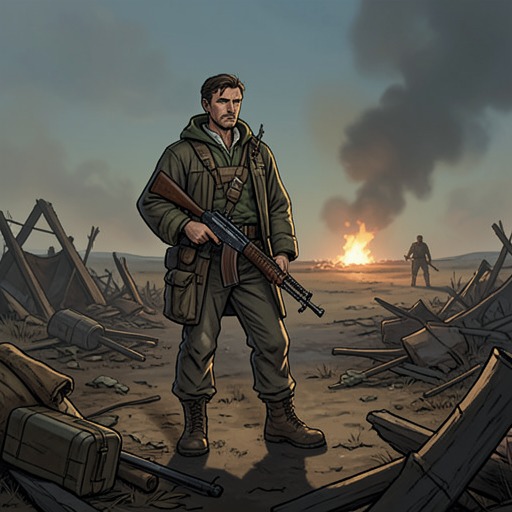
Hig and Bangley Establish an Airport Defense Partnership
The Dog StarsHig and Bangley Establish an Airport Defense Partnership is the tacit bargain that turns two wary neighbors into a survival team. Hig supplies the plane and the aerial patrols needed to watch their perimeter; Bangley supplies the guns and the willingness to use them. The arrangement helps keep their isolated base defensible, but the partnership is never simply agreement: Hig’s reluctance to kill and Bangley’s suspicion of outsiders leave a persistent moral divide inside their shared security system.
Unequal but reciprocal roles
Hig understands their dependence as a division of labor. He has the plane and serves as the eyes from above; Bangley has the guns and serves as the muscle on the ground. Their capacities do not overlap neatly. Bangley cannot fly, while Hig does not have the stomach for killing, so neither can readily replace the other without weakening their defense. Hig recognizes that the arrangement is not sentimental: Bangley has saved him repeatedly, and protecting one another has become part of the work required to stay alive.
The airport’s perimeter makes Hig’s role more than a convenience. When Jasper snaps at Bangley during one of Bangley’s visits, Bangley draws his sidearm. Hig intervenes, warning that shooting Jasper would put everyone’s survival at risk. He explains that his patrols from the air are the only way they know to secure the perimeter. The argument establishes that the dog, the pilot, and the armed defender are connected within a single defensive system: the partnership depends not only on Bangley’s weapons but also on Hig’s continued willingness to fly.
A bargain without negotiation
The partnership takes shape without a formal agreement. Hig recalls that there is no extended discussion of conditions: he flies, Bangley kills when he judges it necessary, and Jasper growls. Each tolerates the others’ place in the arrangement. Their silence is itself significant. The two men do not resolve their differences before joining forces; they find a division of labor that makes cooperation possible despite those differences.
Bangley periodically says that he could fly the plane. Hig hears the remark as a warning, though he also observes that, if Bangley truly wanted the exposed, windy place to himself, he could have taken it long before. The recurring boast gives their otherwise settled arrangement an edge of mistrust. Bangley’s indispensable role does not make him unthreatening to Hig, and Hig’s usefulness does not mean their positions are secure by mutual confidence alone.
Security, resources, and isolation
Bangley defends their arrangement by pointing to its material completeness: they have the perimeter, water, power, food, firepower, and nearby mountains where they can hunt if game becomes scarce. With only Hig and Bangley, he argues, there is no internal politics or larger group to tear apart. He presents simplicity as a survival advantage, contrasting their small partnership with communities he believes have not survived. His confidence in the system culminates in the conviction that they can keep living this way.
Hig sees the same compactness as both strength and danger. A small group can avoid internal political conflict, but its security rests on the judgment of two men whose principles differ. Bangley’s rule is to treat a visitor as guilty and act before the visitor can become a threat. Hig objects to that presumption: he would rather allow a newcomer time to show that they are human. For Bangley, negotiation risks death; for Hig, refusing every possibility of connection leads toward a different kind of ruin, a life reduced to complete solitude.
The partnership’s limits
The difference is not abstract. Hig remembers the early rule Bangley pressed on him: never negotiate. Later, while confronting an attacker, Hig states that he is not going to kill the man and instead orders him to leave with his companion and remain silent. The episode illustrates that cooperation has not made Hig simply adopt Bangley’s code. He can act within the dangers they face while still drawing a line against killing in that encounter.
Hig’s later reflections set the alliance against two possible futures. If Bangley’s suspicion governs every choice, survival may preserve the perimeter while leaving Hig alone with the cold universe. If people remain capable of helping one another, even modest gestures can make a different kind of community imaginable. The original bargain endures because their skills fit together, not because their beliefs have converged. It is both a practical defense partnership and an ongoing contest over what, beyond physical survival, their defenses are meant to preserve.